Wednesday, June 28, 2006

Anthro-centric global scare-mongering, IX

Is the science accurate or isn't it? This AP article claims that it is:
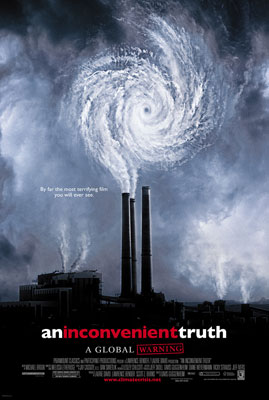
The former vice president's movie ["An Inconvenient Truth"] ... mostly got the science right, said all 19 climate scientists who had seen the movie or read the book and answered questions from The Associated Press.

First thing I wondered was, what book? Is AP talking about "Earth in the Balance"? Then I looked it up on Amazon and found that, yes, there's a companion book with the same title as the movie. I was amused that the Amazon "Best Value" deal for this book didn't pair it up with EITB, but with "The World is Flat".

But putting aside all that, here's another report, this time from the Senate Committee on Environment and Public Works:
In the interest of full disclosure, the AP should release the names of the “more than 100 top climate researchers” they attempted to contact to review “An Inconvenient Truth.” AP should also name all 19 scientists who gave Gore “five stars for accuracy.” AP claims 19 scientists viewed Gore’s movie, but it only quotes five of them in its article. AP should also release the names of the so-called scientific “skeptics” they claim to have contacted.

This, of course, sounds like a political screed. But to me "An Inconvenient Truth" is a political screed.

Someday there's going to have to be a decision made as to whether we're going to actually find out what's causing the current warming trend. Is North America absorbing more CO2 than it produces? Are we overdue for an ice age?

If all you see are the missing legs of this soldier...

...then there's not much for us to talk about.

Staff Sergeant Christian Bagge lost parts of both legs to a roadside bomb in the Iraq desert. When President Bush visited him in the Brooke Army Medical Center last January, he promised Bush that they'd go running together.

If all you see are the missing legs of this soldier, then I'd say that there's a piece missing from your soul.

Make the pledge

From the Center for Small Government comes a new pledge to make this coming 4th of July, a new Declaration of Independence: the Small Government PledgeSM. I did. How about you?
THIS 4TH OF JULY, WHY NOT SIGN THE NEW DECLARATION OF INDEPENDENCE?

By Carla Howell and Michael Cloud


56 Individuals signed the original Declaration of Independence.

The Declaration of Independence was NOT simply a strong expression of political opinion.

It was NOT an attempt to influence, persuade or lobby the King or Government of Great Britain.

It was NOT a mere petition. It said, "We have Petitioned for Redress in the most humble Terms: Our repeated Petitions have been answered only by repeated Injury."

The Declaration of Independence "published and declared" that the "United Colonies are, and of Right ought to be, Free and Independent States; that they are absolved from all Allegiance to the British Crown, and that all political Connection between them and the State of Great-Britain, is and ought to be totally dissolved…"

Then the 56 Signers backed up the declaration with their personal commitments. They wrote, "And for the support of this Declaration…we mutually pledge to each other our Lives, our Fortunes, and our sacred Honor."

To the British government, it was an Act of Treason.

They risked everything. Their homes could be confiscated or burned. Their families might be arrested and imprisoned. They faced the gallows. IF they failed.

Yet their bold declaration and pledge set in motion the events that led to Independence, Liberty, and the United States of America.

If you were alive then, if you had the opportunity, would you have taken the risks those 56 Signers took? Would YOU have signed the Declaration of Independence?

We hope you would have. We hope we would have, too.

But now you have the opportunity to sign the NEW Declaration of Independence: the Small Government Pledge*.

The NEW Declaration of Independence does NOT require you to risk your life, liberty, or property.

It does NOT demand that you sacrifice your life or earnings for the cause of liberty.

It does NOT require you to suffer to advance or achieve liberty.

The only way to expand liberty is to shrink government. The only way to restore liberty is make government small.

The only way you can get small government is to vote small government. And that begins with taking - and living by - the Small Government Pledge*:

The Small Government Pledge* makes sure that every choice you make, every vote you cast moves toward small government and liberty.

The Small Government Pledge* is an ACTION pledge, not just a statement of belief, principles, or positions.

It's simple and direct.

Do you sincerely want to make government small? If so, take the Small Government Pledge*!

The Small Government Pledge*

"I vote small government. Every issue. Every time. No exceptions. No excuses.

"Here's what the Small Government Pledge* means:

1. I will vote for and support only those candidates who consistently vote for small government; who work to make government smaller than it is today. For candidates who have never served in office, I will vote only for those who campaign to make government smaller than it is today.

2. I will vote against and refuse to support every candidate who votes to sustain or enlarge today's Big Government - or campaigns for it.

3. I will vote in every federal, state, and local election. If necessary, I'll get an absentee ballot. I'll find out about the choices on my ballot - and make sure I always vote small government.

4. If there is no small government candidate on the ballot, I will either write in and vote for a small government candidate or leave the ballot blank for that office.

5. I will vote for every ballot initiative and referendum that shrinks the size, spending, taxes, scope, or power of today's Big Government.

6. I will vote against every ballot initiative, referendum, and bond that increases the size, spending, taxes, scope, or power of today's Big Government."

Will you celebrate this 4th of July by reading and signing the NEW Declaration of Independence – the Small Government Pledge*?

Click here to take the Small Government Pledge* and get a printable certificate you can sign and hang on your wall:

http://www.centerforsmallgovernment.com/SGPvoterform.htm

Have you already signed the Small Government Pledge*? Check by clicking here: http://www.centerforsmallgovernment.com/signers.htm


2006 Copyright Carla Howell and Michael Cloud
* "small government is possible", "small government is beautiful", "Small Government Pledge" and "Small Government News" are Service Marks (SM) of Carla Howell and Michael Cloud. "Personal Responsibility Sets Us Free" is a Service Mark of Michael Cloud.


Tuesday, June 27, 2006

I love stories like this, LXII

Oh, dear! No more dodgeball. No more touch football. No more tag, fer cry-yi! Your children will be spared the potential bumps and bruises of these vicious recess games:
In January, Freedom Elementary School in Cheyenne prohibited tag at recess because it "progresses easily into slapping and hitting and pushing instead of just touching," Principal Cindy Farwell says.

Well, I guess so. Maybe if the schools would get with it and supply protective padding for the kids that want to play tag. Perhaps Everlast could come up with a variation on its sparring gear for boxing and adapt it for grade school games of tag. We wouldn't want the kids to get skinned knees or anything, or suffer the trauma of actually being tagged and shouted at derisively: "You're it!" Oh, the humanity!

Sunday, June 25, 2006

Excellent op-ed

From the Washington Times, an excellent op-ed by Diana West called "Deluded America". The point she makes is that these days we seem to believe that war shouldn't sully one's hands; and that morally superior people
never "humiliate" prisoners, never kill civilians, never torture or incarcerate jihadists. Indeed, they would like to kill, I mean, prosecute, or at least tie the hands of, anyone who does. This, of course, only enhances their own moral superiority. But it doesn't win wars. And it won't save civilization.

Why not? Because such smugness masks a massive moral paralysis. The morally superior (read: paralyzed) don't really take sides, don't really believe one culture is qualitatively better or worse than the other. They don't even believe one culture is just plain different from the other. Only in this atmosphere of politically correct and perpetually adolescent non-judgmentalism could anyone believe, for example, that compelling, forcing or torturing a jihadist terrorist to get information to save a city undermines our "values" in any way. It undermines nothing — except the jihad.

Do such tactics diminish our inviolate sanctimony? You bet. But so what? The alternative is to follow our precious rules and hope the barbarians will leave us alone, or, perhaps, not deal with us too harshly. Fond hope. Consider the 21st-century return of (I still can't quite believe it) beheadings. The first French Republic aside, who on God's modern green earth ever imagined a head being hacked off the human body before we were confronted with Islamic jihad? Civilization itself is forever dimmed — again.

During the last Presidential campaign, John Kerry said
We have to get back to the place we were, where terrorists are not the focus of our lives but they're a nuisance.

That was just one of the things – that 9/10 attitude – that caused me to vote for Bush.

Saturday, June 24, 2006

My sentiments exactly

We haven't watched any television for 6-1/2 years. The last football game I watched was Green Bay's loss to Denver in the Super Bowl. Occasionally I'll feel a twinge when I know that the British Open Golf tournament or the Masters is on TV, but it soon passes.

I've become aware that soccer has gained in popularity, what with the term "soccer mom" and all. I'm also aware that the World Cup is going on right now.

But when I read about the U.S. losing to Ghana in a game "they had to win", I was somewhat less than interested. Now I see that James Taranto of Best of the Web Today feels the same way:
At first this Associated Press dispatch sounded like bad news:
There was no glory for the United States at this year's World Cup, only frustration and failure.

Done in by their own mistakes and a crucial penalty call, the Americans lost to Ghana 2-1 Thursday in a game they had to win to advance past the tournament's first round.


But don't worry. We did some research, and it turns out they were only playing soccer. And let's be honest: People who play soccer deserve to lose to Ghana.

Thursday, June 22, 2006

More on protectionism

After I posted my correspondence with Jerry Pournelle I got a couple of comments from one of my most faithful readers, Susan H. in Kentucky. Since she refuses to get a Blogger account so that she has a proper signature, I just know it's her. So, when you see "Anonymous" below, think "Susan":

Anonymous said...
I wish I could remember all the "jobs" I've had over the years. And here I am, pushing 50 and learning a new trade because computer publishing is on the wane. My market doesn't have the same ramifications of global exodus as many manufacturing industries, but technical publishing is definitely in trouble. (It will fix itself, but not in time for me.) Why protect those in global bubbles, but not me? Personally, I don't want the protection, but the question's valid.

Steve Erbach said...Susan (at least, I presume it's Susan),
When you say the technical publishing is in trouble, do you mean that fewer hardcopy books are being published, or that fewer copies of books are selling...? I subscribe to Safari Books Online and I find that it's very handy. The publishers, I'm sure, get some pittance every month for every book of theirs that winds up on subscribers' bookshelves. Looks to me like the Safari model might be a model for, say, new fiction or cookbooks, too. Yes, one has to have a computer to access the books, but as wireless becomes more prevalent and portable e-book readers get lighter and more convenient, there'll be fewer books in the brick-and-mortar bookstores.

I'm going to quote from a correspondent on Pournelle's site regarding the changes in publishing. He was reacting to my job exportation post:
In my view, book publishing has already changed. Conventional book publishing is a mass market phenomenon, which seeks to satisfy all initial demands by choking every channel of distribution. The result of this is overprinting of those few titles that do make it through the marketing department's gauntlet of what they think will sell. (Forget about literary merit. That has been delegated to the professional agents who must pass on all entries to this race and have exclusive rights of presentation. Since they can only make a living by presenting 'best sellers' the midlist has disappeared, as has the careful nurture of new talent for the long term. Maxwell Perkins is very dead at this point.) This crisis especially affects fiction, which is forced into defined genres that must meet these same expectations, and a marketplace where non-fiction is the preferred flavor. Since the incremental cost of printing another book shrinks as the the quantity goes up, the result is a glut of books.

Because of the doctrine in law called 'First Sale', no further author royalties will be paid, and because of the disintermediation provided by the Internet, a secondary market in used copies quickly springs up, driving the price on some as low as a penny when the new copies cost as much as thirty dollars. This puts authors in a nice little squeeze. Selling the next book depends very much on whether or not the advance for the present one has been 'earned out'. Complicating that is the fact that the size of the advance dictates the size of the promotional budget. If that is not adequate, then unsold copies soon crowd the remainder sales table. No one maintains a backlist anymore. For tax reasons, as well as the fact that storage costs.

The disintermediation in the marketplace provided by on-line booksellers has led to the gradual disappearance of the small independent bookstore. Only chains have the economies of scale to survive the costs of direct retailing and their selection pales next to that of Amazon and the rest. Indeed, the 80/20 rule applies here, with most of the books on the shelves selling so seldom that they are known in the trade as 'wallpaper'. Retailers cannot make up the difference with special orders or even better coffee. If one is going to go to the trouble of ordering a book, then the Internet provides a much easier and more convenient method. And people who used to sell books to used book stores now have found that Amazon and eBay give them a much more diverse and profitable channel. So the used book store has retreated from the street to the spare bedroom, with a marketplace that is open 24/7. I do this myself a little, and most of my stock comes from library and other charity sales. Most of it is work long out of print, so the canard that used book sales on the Internet hurt those of new books is not entirely accurate. Again the 80/20 rules applies.

The future of publishing may be changed by the advent of 'print on demand' books. Many small presses have already taken this route since it allows them to closely match supply to demand. E-books will continue to be a niche category because they really have to be printed out to be read with any ease. (I speak as the publisher of these.) What e-books do provide is another form of disintermediation by eliminating the conventional publishers from the equation. As they demand more perfect, ready to sell, texts, the advantage in small publications shifts to the author who is willing to to make a more direct connection to the consumer. Amazon Shorts is a case in point. I am not the only author who is serializing a novel there, and one was recently dropped in six parts at once. The genius of this program is that it allows everything to be printed out and gives authors a much higher royalty than conventional publishing. with its multiple levels of distribution, allows. My current novel, in 14 parts, will ultimately pay me a better per copy royalty than conventional hardbound publication probably will. And there are no remainders. It is no coincidence that Amazon now has its own "Print on Demand" book printing company.

So what is to be done, is for authors to become better business people and embrace these changes in the marketplace and the technology for delivering text to customers and give serious consideration to not letting old school publishers and agents dictate the terms by which their work is published. Supply and demand is a sword with more than one edge.

Sincerely,

Francis Hamit

Regards,

Steve Erbach
The Town Crank

Anonymous said...
Nice analyzation, but the question was about protecting markets, not making it in the publishing industry. :)

Everything changes -- I've never had a job where we all sat tight and repeated our mantra day in and day out -- you adjust, change, or you die. I just haven't been fortunate enough to be in a business that didn't have to adjust to changing technology or the market. I don't see why anyone would want to protect a global market from the innovations forced by the market.

Steve Erbach said...
Susan,
Nice analyzation, but the question was about protecting markets, not making it in the publishing industry. :)

Heh! I admit that I focused only on your remark about technical publishing being in trouble.
I don't see why anyone would want to protect a global market from the innovations forced by the market.

I don't see how anyone could protect a "global market"! There's a global market for automobiles, so, I suppose, the individual companies and countries that benefit from that market are interested in shutting out competition for personal transportation.

Say that somebody invented a really practical, safe, inexpensive, and roomy hovercraft that could not only glide down city streets but could scoot over water and rough terrain. I imagine that the existing lobbying muscle of the auto industry could see to it (since the legislators are covered with auto industy pocket lint) that hovercraft were subjected to extraordinary regulatory requirements that would raise the bar for hovercraft manufacturers and make it tougher for them to make headway.

Is that what you're talking about? If not, would you care to expand?

Steve Erbach
The Town Crank

I'll add to this if there's any more.

FWIW, ladies and gentlemen, WMD in Iraq

Here is a 129 KB PDF of a 4-page fax sent from the House Permanent Committee on Intelligence to Senator Rick Santorum's office. Quite a few chemical "weapons munitions" have been found since the Iraqi incursion.

So, did President Bush lie about WMD's considering that it appears that Saddam Hussein managed to get rid of most but not all of them? "About 500" have been found in three years. How many more are in the hands of the Islamo-fascists?

More on this here and here. Oh! Goodness! That first one is a Fox News story! That couldn't be true, could it?

Wednesday, June 21, 2006

Anthro-centric global scare-mongering, VIII

Two items, actually. This morning I saw a blurb from the China Daily, of all places. Stephen Hawking, the noted astrophysicist, was in Beijing giving a talk before a group of 500 students. Besides saying that he thought that Chinese women were beautiful, Hawking opined that he was
"very worried about global warming." He said he was afraid that Earth "might end up like Venus, at 250 degrees centigrade and raining sulfuric acid."

Ooookaaay. Considering that that's the way the earth started out, maybe he's got a point.

Next, a call to arms from ABC News:
Has your life been directly affected by global warming?

We want to hear and see your stories. Have you noticed changes in your own backyard or hometown? The differences can be large or small — altered blooming schedules, unusual animals that have arrived in your community, higher water levels encroaching on your property.

Show us what you've seen. You can include video material of the environmental change, or simply tell your story via webcam.

I can just see it: somebody with a webcam shows a bunch of wilted flowers, or a pool of standing water that, gasp!, wasn't there last year at this time!!!!!

All I can say is, Oh, gawd!

Sunday, June 18, 2006

Mini-discussion with Jerry Pournelle on jobs

Pournelle carries on an open-ended discussion on the hidden costs involved in manufacturing jobs bleeding away from the U.S. to other countries. He has advocated a 10% "revenue" tariff to act as a barrier to other countries unloading goods here that we have no chance of making at the same price. Those are just a couple of points he talks about.

I jumped into the discussion a couple of weeks ago and was rewarded with some reaction. First I wrote to his web site:
Subject: Walter Williams on Creative Destruction

Dear Jerry,

I've read most of your comments about the abandonment, more or less, of the skilled worker in America, the people that made up a goodly portion of the middle class that have now been cast aside for efficiency's sake. That is, their jobs have leaked away to the Far East. What is to be done with this expanding pool of skilled workers that now have no useful role to play, since their jobs have been filled by, perhaps, several people making a puny fraction of what that skilled worker made?

I know that you're looking for an answer. I don't have one to offer, at least for the question you're posing. I think that "creative destruction" covers the the situation as presented, though the question as to the human cost will settle itself over time.

For example, this brief piece by Walter Williams on "Disappearing Manufacturing Jobs", makes the point. The point being one that we've all heard many times: should something have been done for the buggy whip manufacturers or the whalebone corset manufacturers or the lamp oil manufacturers? What should have been done over the period that our agricultural sector shrank from 41% of the population at the turn of the 20th century down to 2% in the 21st century? (Of course, some will point out that there sure seem to be a lot of illegal immigrants in agriculture, but that's a side issue!) Williams asks what happened to the switchboard operators of the 70s. Anyone can add to this list. American RAM manufacturing jobs, American TV and electronics manufacturing jobs, crafts industry (needles and thread, crocheting, rug hooking, doll making, artificial flowers) manufacturing jobs, flower-picking jobs, office supplies manufacturing jobs, auto manufacturing jobs,...so many of these jobs no longer exist in this country. But how is it that we're still able to buy all of this stuff? Is it because we're borrowing money that can't be paid back? Or is it because we continue to offer things to other countries through our own changing comparitive advantages? I'm certain that the reasons are many, but it sure looks to me like our economy props up a goodly portion of the world.

I try to visualize just what sorts of things would happen to us if we slapped tariffs on everything to allow us to, what? Catch our economic breaths? Restore pensions and health insurance? The industries that overspent on all sorts of things, whether it was fancy-schmancy world headquarters or gold-plated pension plans or expensive product features were bound to fail in world markets eventually. It's that creative destruction that catches up with them.

The only thing that is NOT creatively destroyed anywhere in the entire world is government. And since only government can impose a tariff, I'm sure they'll get around to it during the next administration.

What do you envision would be the result of such a tariff? The preservation of jobs? How many jobs will be lost because the tariff raises the price high enough that less of those protected goods are purchased? I would say just look at the steel tariffs from the early days of the Bush administration. What did they do for us? How many jobs were saved?

I've considered that maybe a 10% tariff would help provide job training for those people most threatened by job losses. But then I wondered whether we'd just be setting up another bureaucracy that would never close up shop but would ask for larger and larger budgets year after year. Pournelle's Iron Law triumphs again. I don't have the answers, but a temporary measure like a 10% tariff for revenue wouldn't do much more than reduce consumption so that that 10% would eventually be counter-balanced by job reductions to offset the reduced demand.

Is it worth trying? Well, sure, pick an industry that's hurting and "save" it with a 10% revenue tariff. I'll make a Julian Simon bet that in 10 years that industry will be less of a factor in the economy than it is today since cheaper and more efficient alternatives will have been found, and that that industry will employ fewer people than today. Matter of fact, I wish there indeed were a way to test this. Simon had a much easier time of it with the bet he had with Ehrlich. They just had to monitor the commodities markets.

What about book publishing? What if the market for books changed so much that the traditional author/publisher relationship were altered significantly? I mean, hardback book publishing would decline in favor of paperback, then paperbacks would decline in favor of e-books, then e-books would decline in favor of video. You, personally, may not be affected by those sorts of changes in the industry because you have so many areas and interests to write about...and you're in the, shall we say, sunset of your career. But doesn't it seem reasonable to assume that public buying trends regarding book publishing will change beyond recognition? What, if anything, should be done about that?

As a sample of the changing nature of publishing, I just posted a book review of John Derbyshire's new book, "Unknown Quantity" on Amazon.com this week. That's the second of two reviews I've written in two years. Out of curiosity I checked my "ranking". I am currently ranked 259,373rd. I don't know how many reviewers there are, but I do know that the top reviewers have posted more than 10,000 book reviews each! To me it seems one of the easiest ways to get "published" that I know of, except for blogging. But if one posts a book review of a new book right away, the chances are a lot of people interested in that book will read it.

Anyway, I've gotten off the track. Again, I wish there were a way to gather more information about the effects of a limited tariff such as you suggest.

Sincerely,

Steve Erbach
Neenah, WI

Pournelle's reply:
If one's god is Mammon, then maximization of consumption is clearly the proper goal.

I had this conversation with Dr. David Friedman, an old friend among the sanest people I know, last week; it is a repeat conversations I always have with economists: what are the TRUE COSTS of Free Trade in a world in which there are political realities? What is the economic cost of anomie? When you export a job, the benefits are to those who import and sell the goods, and to their customers; when you support the person whose job has been exported by giving him a place at the public trough, who bears the cost? What are those costs? And what is the cost of taking an independent, self-supporting, taxpaying citizen and converting him into a public burden who knows that he is no longer contributing to his society; is no longer the breadwinner for his family? Who knows now that the only way to "get a raise" is to support even greater "social spending"?

What is the economic cost of anomie? I have never heard an answer from the economists.

Nor have I heard an analysis that distinguishes between a job lost due to technological change – the classic buggy whip maker – and a job lost to an overseas sweat shop that pollutes the environment and pays the highest wages in its region – and those are paltry. Creative destruction of poverty in Canton, China is a Good Thing; but is it good for Canton, Ohio? I have seen few analyses that even address these questions.

I then wrote a reply:
Subject: Creative Destruction

Dear Jerry,

» it is a repeat conversations I always have with economists: what are the TRUE COSTS of Free Trade in a world in which there are political realities? What is the economic cost of anomie? When you export a job, the benefits are to those who import and sell the goods, and to their customers; when you support the person whose job has been exported by giving him a place at the public trough, who bears the cost? What are those costs? And what is the cost of taking an independent, self-supporting, taxpaying citizen and converting him into a public burden who knows that he is no longer contributing to his society; is no longer the breadwinner for his family? Who knows now that the only way to "get a raise" is to support even greater "social spending"? «

I hesitate to suggest this, but I think you've just set up a false dichotomy; that is, we either preserve the jobs of those "independent, self-supporting, taxpaying" citizens, or they go on the dole.

As I said in my letter, I don't have any answers. I haven't taught economics as you have; so if YOU don't have any answers, I have exactly zero chance of coming up with any.

However, Dr. Williams makes a point that is germaine to your concern:

"Imagine for a moment that technology hadn't destroyed most of the jobs of those 41 percent of Americans working in agriculture in 1900. Where in the world would we have gotten the manpower to make all those goods produced now that weren't even imagined in 1900? Jobs destroyed through the market forces of creative destruction make us all better off, and that applies also to job destruction that comes from peaceable, voluntary exchange with people in different cities, states and countries."

Now I'm going to indulge in standing up a straw man...fair warning: Are you saying that perhaps this present phenomenon of the export of jobs "to an overseas sweat shop that pollutes the environment and pays the highest wages in its region" is so different in kind from anything that has gone before that we're in danger of [FILL IN THE BLANK WITH HORRIFYING FUTURE SHOCK-TYPE CATACLYSMIC SOCIAL UPHEAVAL]?

I loved your book, "A Step Farther Out". If you accept the erection of my straw man, it would sure seem as if you reject the premises on which you based your book. Or am I now guilty of offering up a red herring?

Sincerely,

Steve Erbach

To which he replied:
Yes. I am saying that there is a fundamental difference between having a job go out of existence because not needed, and having it exported to a place that has no environmental laws, no minimum wages, no health care; precisely in the same way as it would be different if we imported slaves to do someone's job, then conscripted him into the army to help suppress the slaves.

And finally I wrote this:
Re: Creative Destruction

Dear Jerry,

Your reply stayed with me this past week until I was re-reading Paul Johnson's "A History of the American People". He wrote about the rapid loss of manufacturing share the U.S. experienced in the 70's, as well as the "spate of regulatory legislation passed by Congress in the 1960s and 1970s." As a result American business productivity suffered. The decade of 1967-1977 saw American manufacturing productivity grow by only 27% compared with 70% in West Germany, 72% in France, and 107% in Japan.

Then I realized that you'd put your finger right on it: "no environmental laws, no minimum wages, no health care". That is, we have regulated ourselves out of competitiveness. That's why jobs are being exported to the Far East. Our worker productivity is very high, but it comes at the expense of doing more with fewer workers...because it's become more difficult to employ so many and stay competitive with the amazing regulatory load.

I note that at present EU countries typically have a higher unemployment rate than the U.S. does, as well as high regulatory and tax requirements...and lower productivity. The U.S. was socked by a big regulatory load dropped on us during the 70s so that we fell behind in productivity versus the Euros. But Euro businesses haven't taken to heart the lessons of American businesses confronted with the changing regulatory climate.

A friend of mine wrote during an e-mail discussion that European workers "are healthier, living longer, have lower rates of infant mortality, eat better quality food, are less obese, have access to public transportation and education of which we can only dream." To which I replied, "What I see are the crazy high tax rates, the nationwide strikes, the high unemployment rate, the low worker productivity, the near bankruptcy of their governments, the immigrant unrest that surpasses our own..." So, do European democratic socialist countries have the answer to job exportation? That is, by a greater imposition of the custodial state (as Herrnstein and Murray termed it) than we have in this country?

It looks to me as if the exportation of jobs from our shores is the price we pay for trying to stem the tide of the custodial state.

Sincerely,

Steve Erbach

I tried to summarize all this for a friend yesterday. Mostly I feel that there can be no "solution" to the shift in middle-class manufacturing jobs bleeding away. It looks to me like we've decided that "all men are created equal" can be achieved retroactively through legislation, regulation, and taxation. We are, by God!, going to make sure that everyone has an equal shot at everything. So since manufacturing jobs are more hazardous than office jobs, we responded by establishing OSHA and imposing a regulatory bureaucracy. Since there was too much emphasis on male-only sports in public colleges, we responded by establishing the Title IX bureaucracy. Since medical care is beyond the means of lots of folks, we responded with the Medicare / Medicaid / insurance bureaucracies.

Pournelle's Iron Law of Bureaucracy is the explanation for why manufacturing jobs have fled our shores. We can't be competitive if Indian iron foundries, for example, allow their workers to wear nothing but loincloths. Or where shoe factories in the Far East employ natives at a tiny fraction of what the ILGWU workers used to make over here. We have regulated ourselves out of competitiveness. To stay in business, corporations employ overseas workers in manufacturing because if the stuff was made in the U.S.A., no one would buy it because it'd be too expensive.

Friday, June 09, 2006

Recent commentary: Delayed information

How do you feel about the delayed public release of information in stories such as the VA data theft and Haditha massacre?

(published 12-Jun-2006, Appleton Post-Crescent)

I remember feelings I had during the Cheney shooting incident: bemusement and distaste. Bemused by the astounding uproar in the national media over the so-called coverup...and distaste for the media, not that that's hard. I read about JFK in Paul Johnson's excellent "A History of the American People". Nobody thought anything of the press covering for Kennedy during his campaign and for his entire time in office: his philandering, back problems, health problems, etc. Information has been delayed for as long as news has been gathered. Consider, too, the stories rushed into print or on-the-air without complete fact-checking. An excellent recent example -- one that a certain CBS producer just won't admit -- was the story based on phony documents asserting that President Bush was AWOL during his National Guard stint. All I can say is that it's tough all over, but the press is doing its job.

Monday, June 05, 2006

Anthro-centric global scare-mongering, VII

The College Republicans at Oklahoma University have the right idea for honoring Al Gore's new movie, "An Inconvenient Truth": give away free snow cones for "Global Cooling Day".
Stage an event like this one to grab the attention of your campus and raise awareness on the real facts of the global warming phenomenon. Engage with students and debunk some of the myths and cool the hyperbole surrounding the issue.

Of course, the adults in the global warming movement are not amused:
"The College Republicans' beach parties mocking global warming are just another example of the misplaced priorities and short- sightedness of the Republican Party," said College Democrats of America President Grant Woodard. "The College Republicans' ignorance toward the seriousness of global warming and climate change shows a Party more focused on partying than talking seriously about the issues facing young people across America. While College Republicans party on this summer, College Democrats will be knocking on doors, working to get Democrats elected nationwide. With young leadership like this, Republicans should prepare to get burned in the upcoming elections."

Oh, dear! Dr. Bill Gray of Colorado State University has the right attitude, I think. He was interviewed by David Harsanyi of the Denver Post:
Gray is perhaps the world's foremost hurricane expert. His Tropical Storm Forecast sets the standard. Yet, his criticism of the global warming "hoax" makes him an outcast.

"They've been brainwashing us for 20 years," Gray says. "Starting with the nuclear winter and now with the global warming. This scare will also run its course. In 15-20 years, we'll look back and see what a hoax this was."

Gray directs me to a 1975 Newsweek article that whipped up a different fear: a coming ice age.

"Climatologists," reads the piece, "are pessimistic that political leaders will take any positive action to compensate for the climatic change. ... The longer the planners delay, the more difficult will they find it to cope with climatic change once the results become grim reality."

Thank God they did nothing. Imagine how warm we'd be?

Indeed.

Sunday, June 04, 2006

Sad news for fans of WHAMCO

A few weeks ago I announced that my WHAMCO site was complete. That is, every WHAMCO radio commercial had been re-recorded in Windows Media format with all the pops and clicks from the original LP's removed by Lee Withers of KONA in Washington.

Well, yesterday Mr. Withers wrote me with sad news about the death of Steven B. Williams, the glorious announcer voice of the Denver radio team:
...direct from ABC Radio: "At one time the morning team of STEVEN B. and THE HAWK were big in the ratings in Denver. Steven B. Williams moved to California 5 years ago and ended up working in a winery. Now his body has been found floating in the ocean off Catalina Island with a gunshot wound to the torso. The owner of a winery where he used to work said he was a great guy and that getting the news was strange because he was just about to call Williams to see if he'd come back to work for him. Police have no motive, no suspects, and aren't even sure where to start looking."

Best laugh of the week, I

I normally read Walter Williams' columns for a breath of fresh air when all the jabber about evil profits and evil Walmart and evil corporations gets me down. Today I read his May 31st column on why we're not being gouged at the gas pump. Dr. Williams uses an extremely easy to understand line of reasoning:
Say you owned a small 10-pound inventory of coffee that you purchased for $3 a pound. Each week you'd sell me a pound for $3.25. Suppose a freeze in Brazil destroyed half of its coffee crop, causing the world price of coffee to immediately rise to $5 a pound. You still have coffee that you purchased before the jump in prices. When I stop by to buy another pound of coffee from you, how much will you charge me? I'm betting that you're going to charge me at least $5 a pound. Why? Because that's today's cost to replace your inventory.

The best laugh of the week came at the end of the column:
CEOs tend to be cowards when dealing with politicians and environmental extremists, but I have a recommendation that requires only a modicum of courage. At each gasoline station they should put up photos, perhaps videos, of penguins, caribou, polar bears and other critters frolicking along Alaska's coastal plain. Then have a voice-over or caption reading:

Don't be selfish. Your paying $3, $4 and $5 a gallon for gas keeps these critters happy and their play space clear of oil rigs.

Can you dig it? Penguins in Alaska!! I'm still chuckling!

Next: cloned jockeys on cloned mules?

What better was to demonstrate a scientific achievement than a sporting event? Two mules cloned from the same champion racer (mule racing? Yes sir!) finished 1st in their respective heats in a recent race in Nevada:
Idaho Gem covered his 350-yard sprint Saturday in 21.817 seconds, winning by 1 1/4 lengths over five rivals. Idaho Star was less than three hundredths of a second faster, finishing in 21.790 seconds to win by a half length over four competitors.

"For both to win first, it is awesome," said Don Jacklin, an Idaho businessman who helped finance the cloning project. "I think it is going to open a lot of eyes as far as cloning. I think the race experience will go a long way to show what cloning can do."

Fixing horse -- well, mule -- races by cloning past champions. Now that's genius!

Saturday, June 03, 2006

Egg on the face: Greenpeace

I've heard of people being embarrassed by sending out letters that weren't in final form, but this one takes the cake. A Greenpeace fact sheet distributed during President Bush's tour of Pennsylvania promoting atomic energy said that "This volatile and dangerous source of energy" was not the answer to our energy needs and that nuclear reactors posed a threat. But then came the rough draft phase of the fact sheet:
In the twenty years since the Chernobyl tragedy, the world's worst nuclear accident, there have been nearly [FILL IN ALARMIST AND ARMAGEDDONIST FACTOID HERE]

The fact sheet was evidently rushed to the laser printer without too much proofing. That "fill in the blank" remark was, apparently, a joke inserted by a Greenpeace staffer.

As far as egg on the face, I just wish these outfits had as much of a sense of humor as James Carville does. Carville smashed an egg on his head on "Meet the Press" after the 2004 Presidential election to symbolize how wrong his predictions were. Not that Greenpeace will ever admit that they're wrong about atomic power...

Tuesday, May 30, 2006

Anthro-centric global scare mongering, VI

I wish that someone could tell me what this means:
We face a challenge in the conversation of democracy that we must be up to in order to save the climate balance on which our civilisation depends.

These were part of prepared remarks given by former Vice President, Al Gore, at the Hay Festival in the United Kingdom. "Prepared", I said. Can you imagine what the semantic content of the rest of his speech must have been? Can you say "Zilch"?

I see where Mr. Gore's new film, "An Inconvenient Truth", scored well on a per-theatre average over the Memorial Day weekend. It earned $366,000 in four theatres. That's $91,500 per theatre, far outstripping "X-Men's" $32,554 average. Of course "X-Men" ran in 3690 theaters. I will certainly see this movie when it comes to my area. I see it having about as much effect on public policy as "X-Men", too.

Since anthro-centric global warming can only be mitigated through political action, I wonder if that action will be as effective as President Bush's attempt to privatize Social Security. Yes, yes, I know they have nothing to do with each other. But both issues are thoroughly political, even though advocates for both claim a huge body of evidence supports the political action required.

This may be the best hope for those who, like me, have strong doubts about the impact humans can have on the climate. That is, if we look at the results of the attempt to privatize Social Security all at once -- and going further back, the attempt to nationalize health care during the Clinton administration -- we can take heart that people are basically conservative, meaning that they're resistant to change. The "third rail" of politics remains untouchable. That was proved by the failure of privatization and the assurances opponents put forward that Social Security really isn't in danger. Enacting massive measures to reverse climate change will fail, too, primarily because the "sea change" Gore talked about in his speech won't take place.

I think that for massive policy changes to pass there would have to be a climate upheaval as lengthy and dramatic as the Great Depression was for the economic "climate". I mean, FDR and Congress were able to push through a huge amount of legislation establishing social programs because they saw that they had to "do something". Hurricane Katrina isn't enough for global warming legislation to be passed. There'll have to be a decade-long drought and record-breaking high temperatures across the country every year, all year. I just don't see it happening. Not that I'm unhappy about that, you understand...

Thursday, May 25, 2006

Recent commentary: What mosquitoes?

What's the best way to fend off mosquitoes?

(published 29-May-2006, Appleton Post-Crescent)

I don't get bitten very much during the mosquito season. I don't know why. I like to think it's because of clean living and good will towards all living creatures. Maybe I have a rare gift, that mosquito saliva doesn't cause an allergic reaction, or whatever it is that happens when you're bitten. Perhaps because of my distaste for repellent my body has developed a natural repellent. Who knows? Remember the scene from "Lilo and Stitch" where Agent Pleakley, the inter-galactic endangered species protector, attracts Earth's most precious “endangered species”, the mosquito? "Look! A mosquito has chosen me as her perch. She's so beautiful! There's another one, and another. It's a whole flock! They like me! They're nuzzling my flesh with their noses. Now they're... they're... Aaaarrrrrrggggghhhh!!!" I'm just not affected like that. So who needs mosquito repellent? Now, if you'd asked me about cat repellent, then you'd be talking!

A truth that's inconvenient

"An Inconvenient Truth" debuts this weekend around the world. It's Al Gore's fabulous political platform to preach about anthro-centric global warming.

In an article written for TechCentralStation.com, Dr. Robert Balling suggests that we keep in mind certain things while watching this paean to environmentalism. For example:
You will certainly not be surprised to see Katrina, other hurricanes, tornadoes, flash floods, and many types of severe weather events linked by Gore to global warming. However, if one took the time to read the downloadable "Summary for Policymakers" in the latest report from the United Nations Intergovernmental Panel on Climate Change (IPCC), one would learn that "No systematic changes in the frequency of tornadoes, thunder days, or hail events are evident in the limited areas analysed" and that "Changes globally in tropical and extra-tropical storm intensity and frequency are dominated by inter-decadal and multi-decadal variations, with no significant trends evident over the 20th century."

Another of Dr. Balling's points bears highlighting:
Near the beginning of the film, Gore pays respects to his Harvard mentor and inspiration, Dr. Roger Revelle. Gore praises Revelle for his discovery that atmospheric CO2 levels were rising and could potentially contribute to higher temperatures at a global scale. There is no mention of Revelle's article published in the early 1990s concluding that the science is "too uncertain to justify drastic action." (S.F. Singer, C. Starr, and R. Revelle, "What to do about Greenhouse Warming: Look Before You Leap." Cosmos 1 (1993) 28-33.)

For me the most interesting tidbit came at the end of Dr. Balling's article:
Throughout the film Gore displays his passion for the global warming issue, and it is obvious that he has dedicated a substantial amount of time to learning about climate change and the greenhouse effect. This leads to an obvious question. The Kyoto Protocol was negotiated in December of 1997 giving the Clinton-Gore administration more than three years to present the Protocol to the United States Senate for ratification. Given Gore's position in the senate and his knowledge and passion for global warming, one must wonder why then Vice President Gore did not seize on what appears to have been an opportunity of a lifetime?

I will certainly see "An Inconvenient Truth" and I'll try to remember that it wasn't scripted by Whitley Streiber and Art Bell. I promise.

Wednesday, May 24, 2006

Amazon book review: Unknown Quantity

A fine biographical history of algebra

Unknown Quantity - A Real and Imaginary History of Algebra
by John Derbyshire

Publisher: Joseph Henry Press (May 15, 2006)
Language: English
ISBN: 030909657X

I had high hopes for UQ. My hopes were not dashed, but I wasn't as uplifted and exalted as I was with Derbyshire's excellent "Prime Obsession". If one comes upon these two books for the first time, one should definitely read UQ first.

As in "Prime Obsession", Derbyshire writes very appealingly about the history of the times and about the mathematicians themselves. The biggest issue is that the book is too small for such a huge subject. It's only 320 pages long with 32 pages of notes.

Derbyshire's portraits of algebraists in his book are uniformly delicious. His bio of Alexander Grothendieck reminded me of the life of former world chess champion, Bobby Fischer. Grothendieck was as unworldly, uninformed, naively opinionated, anti-American, and brilliant as Fischer. We find him now holed up in a remote village in the Pyrenees, where "he is known to come up with ideas like living on dandelion soup and nothing else."

Or Solomon Lefschetz, the algebraic geometer, who lost both his hands in an industrial accident. He was "energetic, sarcastic, and opinionated", and something of a character. His most famous quote: "It was my lot to plant the harpoon of algebraic topology into the body of the whale of algebraic geometry."

I think that Derbyshire had to edit severely. His introduction to "Unknown Quantity" says that it was "written for the curious nonmathematician." Perhaps he should have said, "written for the college math major who decided not to pursue a career in mathematics." I studied math in college but I didn't get a degree. I mention this because I was disappointed by the blandness with which he writes of the "simple substitution" one can make if one only notices the "simple algebraic fact" that turns a general cubic equation into a depressed cubic equation. It's something I never encountered in high school or college. Granted, that was 35 years ago now. I tried for quite some time over a period of three days to derive the "simple algebraic fact" for myself before moving on with the rest of the Cubic and Quartic Equations chapter, but I couldn't. And this was only page 58!

Derbyshire's math primer interludes are designated with initials. So, instead of referring to a section in "Cubic and Quartic Equations" as section 4.7 as he does for all the non-primer chapters, he uses abbreviations: section CQ.7 for "section 7 of the Cubic and Quartic Equations chapter". A bit annoying, actually. If one wishes to brush up on a concept by re-reading, one has to refer first to the table of contents to find it.

However, there are plenty of interesting things to learn for the "curious nonmathematician". For example, the complex cube roots of the number 1. I found this fascinating. I didn't do much with complex numbers in school. Derbyshire whetted my appetite for them in "Prime Obsession" and UQ sated me!

I loved matrices and determinants in high school. They made complete sense to me. The section on the discovery and application of matrices was a comfortable interlude of re-discovery. So was the discussion of Boolean algebra. A few of the chapters weren't. I felt myself to be way outside the book's target audience even though I'm a "curious nonmathematician".

UQ is not as sprightly as "Prime Obsession". The jokes are there, just more widely spaced and drier. The best chuckle I had was in one of the notes in which the author wrote of a video "demonstrating one of the 20th century's most fascinating discoveries in topology: how to turn a sphere inside out." He recalls that he "used to bring it out and play it to dinner guests as a conversation piece, but this was not an unqualified social success."

Derbyshire continues his practice (begun in "Prime Obsession") of collecting all of the footnotes into a set of endnotes at the back of the book. As I said, the best laugh of the book is in one of those notes, but if you don't care to keep flipping back there to find the right note, you might miss it. At least the notes are numbered consecutively; the numbering doesn't start over again with each chapter. But I sure enjoy sidebars and footnotes as part of the text.

Part of what made "Prime Obsession" so vivid were the illustrations. Algebra uses symbols that don't lend themselves to illustration very readily, except where geometric figures can be plotted from algebraic equations. But even in his chapter on geometry Derbyshire's use of illustrations is stingy.

UQ did prove useful right away, though. In skimming through references to help my 15-year-old son find material for a paper on Archimedes, I found a mention of Archimedes' Cattle Problem in the 11th edition of the Encyclopaedia Britannica. The invaluable Mathworld web site contained a more detailed article. I worked on the problem for some time while reading UQ, but I didn't pursue it to a solution. I now realize, though, that both Newton's method and the use of determinants would have solved it...both of which are covered in detail in UQ!

"Unknown Quantity" is a fine historical and biographical treatment of algebra, with engaging writing and plentiful -- though brief -- explorations of a multitude of algebraic topics. There's plenty of meat here for the "curious nonmathematician".

Recent commentary: Border control

Should the National Guard be used to secure the U.S.-Mexico border?

(not published 22-May-2006 in the Appleton Post-Crescent)

On the whole it’s a silly idea: send the National Guard down there – and only 6,000 of them! – for two-week shifts. That will accomplish exactly nothing. Considering what illegals are costing us now in health care alone, we should be able to devote a good million dollars per mile of border every year to interdict the flow. This goes against my belief that peaceful people should be allowed to cross international borders freely; but I’m concerned about the immiscibility of the huge number of illegals into the American Melting Pot. Have you seen references to “Mexifornia”? Don’t laugh! It looks mighty possible. I have to admit that Jerry Pournelle’s idea of a $2000 bounty for every illegal rounded up and delivered to the border makes some sense. I’ll just bet that the most effective bounty hunters would be legal immigrants! In any event, the National Guard scheme is pitiful.

Come a little closer

From TechCentralStation.com today, Will Farrell as United States President George W. Bush and John Lovitz as Iranian President Mahmoud Ahmadinejad. This is a must-read. A sample:

America: We hereby declare ourselves open to discussions with Iran.

Iran: Excellent. Hey, America...why don't you come a little closer?

America: All right. Is this close enough?

Iran: Perfect.

America: Now, the first matter on our agenda is AAAAAAAARRRRRGGGGHHH! I'm crippled by indescribable agony! Why did you do that?

Iran: Do what?

America: You... you just kicked me in the crotch!

Iran: That's one interpretation of events, but History will be the true judge.

America: I can't negotiate with people who kick me in the crotch!

Iran: Surely, America -- the modern colossus, the new Rome, the sole superpower -- can stand to be kicked in the crotch once in a while. Surely, American magnanimity can allow a humble upstart nation a single, one-shot kick to the groin.

America: Well, okay, but promise not to do it again.

Iran: I promise. Come a little closer, why don't you?

America: All right. Now, turning to the AAAAAAARRRRRRGGGGHHHHH! My...God! It burns! It burns with the heat of a thousand suns frying my innards! You broke your promise!

Iran: We understood our promise to be hortatory, rather than binding.

Now that is one of the great all-time most useful weasel-wording lines I've ever seen! More at TechCentralStation.com!

Monday, May 22, 2006

Amazon book review: The Story of Thought

I wrote this some time ago, maybe a couple of years after I'd received Bryan Magee's The Story of Thought for Christmas.

The Story of Thought: (The Essential Guide To The History of Western Philosophy)
by Bryan Magee

Publisher: DK Publishing / QPB edition; 1st edition (1998)
Language: English
ISBN: 0789444550

The author, Bryan Magee, is best known -- at least in England -- for his television series on philosophy, "Men of Ideas," "Thinking Aloud," and "The Great Philosophers." I knew nothing about them when I was given "The Story of Thought" for Christmas. I only know that this is a wonderful book.

In highly readable and lively text accompanied by beautiful pictures, Magee describes the development of Western philosophy by examining and sampling the works of its main proponents, from Socrates to Sartre.

In each vignette Magee highlights the philosopher's main ideas... Don't worry, Magee takes the main philosophical theme apart and reassembles it in modern (and understandable) language.

That's one of the two greatest features about this book: Magee's ability to explain what these great philosophers had to say. It's pretty widely accepted that if you delve into philosophy you rapidly become hip-deep in obscure and difficult language and definitions. Magee points out the philosophers who were most guilty of writing in dense and undigestible prose: most of Fichte's writings, for example, "were extremely obscure," and Immanuel Kant, called by many the most outstanding philosopher since the Greeks, "was not an attractive writer."

However Magee reveals that many philosophers wrote beautifully: Thomas Hobbes was "trenchant and agressive;" Rene Descartes was "a superlative writer;" William James had "an exceptionally pleasing style."

"The Story of Thought" makes you believe that you'd like to study philosophy yourself. Magee makes it attractive and relevant to the way we live. In his hands it becomes much more than a tortured explanation of why we exist or what thought really is. Magee shows us that, "Philosophy begins when human beings start trying to understand the world, not through religion or by accepting authority but through the use of reason."

The second great feature of the book is based on the fact that Magee is obviously an art lover. "The Story of Thought" is beautifully illustrated and, frankly, I keep coming back to it because of the pictures. There are close to 400 illustrations: paintings, sculpture, photographs, book covers, and diagrams in this 240 page book. But the pictures support the text in the best way, by conveying difficult ideas in visual terms and by putting faces to these deep thinkers.

Magee illustrates the power of the ideas in his examination of each philosopher. For example John Locke influenced the American and the French revolutions; Rousseau argued that feelings should replace reason; and, of course, Galileo and Newton whose experiments and scientific ideas shape everything in modern life.

Magee reserves some of his most piercing analysis for Karl Marx. The largest revolutions in history, in Russia and China, were sparked by Marxist theory. Many intellectuals in Third World countries were attracted to Marx's concepts of central planning and modernization. By the mid-20th century about a third of the world's people was under the sway of Marxist government.

The power of Marxism is not in doubt; but Magee details how it proved to be fundamentally unsound... Today the most serious Marxist ideas are found only in art as social criticism.

  • "What is justice?" – Socrates
  • "Man is by nature a political animal" – Aristotle
  • "Lord make me chaste, but not yet" – Saint Augustine
  • "Entities should not be multiplied unnecessarily" – William of Ockham
  • "But it still moves, just the same" – Galileo
  • "If I have seen further it is by standing on the shoulders of giants" – Newton
  • "It is much safer for a prince to be feared than loved" – Machiavelli
  • "...the life of man, solitary, poor, nasty, brutish, and short" – Hobbes
  • "I think therefore I am" – Descartes
  • "The true aim of government is liberty" – Spinoza
  • "The soul is the mirror of an indestructible universe" – Leibniz
  • "Reason is the slave of the passions" – Hume
  • "Man was born free, and everywhere is in chains" – Rousseau
  • "Out of the crooked timber of humanity no straight thing can ever be made" – Kant
  • "Architecture is frozen music" – Schelling
  • "Man owes his entire existence to the state" – Hegel
  • "Religion is the opium of the people" – Marx
  • "God is dead" – Nietzsche
  • "The secret of happiness is to face the fact that the world is horrible, horrible, horrible" – Russell
  • "The supreme paradox of all thought is the attempt to discover somthing that thought cannot think" – Kierkegaard
  • "Hell is other people" – Sartre
  • "How can we be sure we are not impostors?" – Lacan

"The Story of Thought" shows us the origins of the ideas we now take for granted and helps us to understand why all of these people thought the way they did.

Voltaire gave us a wonderful reason for studying philosophy: "Superstition sets the whole world in flames; philosophy quenches them." Bryan Magee in "The Story of Thought" reveals not only the source of the flames but how vital and refreshing it can be to quench them.

Friday, May 19, 2006

Sunny D environmental catastrophe!

London's Daily Mail had a story about a Sunny D spill in England. A Gerber storage tank split and 8000 liters spilled into a stream. The picture accompanying the article is pretty nifty!

Dozens of fish were killed, but Gerber acted swiftly and the orange juice didn't get into the nearby Parrett River. The company said that this kind of accident had never occured before.

What was more interesting than the story was the comments section. A sampling:
Just look at it - it's practically luminous! It'd be better off used as the filling in glow sticks.

There we go again killing off animals to prove that this stuff is bad for you. Says it all really - love the colour though!

Oh no! An accident involving dead animals! Quick, hug a tree and point a finger!

I for one think this is plain proof we are in dire need of strict soda control laws.

Maybe Al Gore will make a movie about it...

I will never ever drink Sunny D ever again. How many more fish have to die before we put an end to this madness? I am saddened and hurt by this poor poor tragedy. Those fish were innocent.

Not to worry, the vodka leak will be directed to the same stream.

Update to ILSLT, LXI

As a piquant addendum to the story about Beverly Hills High Schools students being bussed to see erstwhile Presidential candidate, Al Gore's, new film, An Inconvenient Truth, is this story about an oil well steadily pumping 400-500 barrels of crude a day...and it's sitting right next to Beverly Hills High School:
On the streets of Beverly Hills, lined with vast homes, neatly manicured lawns and expensive boutiques oozing with sophistication, an oil well seems out of place.

But in 2000, the structure received an oil derrick's version of a face-lift: hand-painted, teal-colored tiles now adorn each side of the structure, from top to bottom, making it more art than eyesore.

"The unique aspect of it is that alumni put the project together," Beverly Hills High School principal Dan Stepenosky said. "They went to the hospitals and had terminally ill children paint the panels. A lot of our students went with them and contributed to this project."

The project, known as Tower of Hope, consisted of more than 3,000 children from local area hospitals who contributed to the painting of each panel. Each side of the tower represents one of the four seasons.

Isn't that special? I don't know; this was just one of those precious, unlikely juxtaposition-type things that amused me. Here's an oil well on school property -- you can see from the picture that it stands right next to the building -- and the kids are going to be bussed to see a global warming movie. It's piquant irony.

Thursday, May 18, 2006

I love stories like this, LXI

I wonder if they did the same for Michael Moore's film, Fahrenheit 9/11?

From the Drudge Report:
On May 24, 2006, 1,500 Beverly Hills High School students will be boarding 30 gas-guzzling buses across town to see Al Gore's new global warming film 'AN INCONVENIENT TRUTH' at the Arclight Theatre in Hollywood, the DRUDGE REPORT has learned.

Sarah Utley, a science teacher at Beverly Hills High School, explained in an e-mail to staff and students: "This field trip has been funded by a very generous alum!... You get to see the film for free!!!"

Utley would not reveal who is financing the school outing to mark the opening day of the movie.

"We need parent volunteers who can ride the buses and sit in the theatre," Utley said in her pitch. "The buses are arriving at 8:00am and will arrive back at BHHS by 1:00pm."

The film's urgent trailer warns: "Humanity is sitting on a ticking time bomb. If the vast majority of the world's scientists are right, we have just ten years to avert a major catastrophe that could send our entire planet into a tail-spin of epic destruction involving extreme weather, floods, droughts, epidemics and killer heat waves beyond anything we have ever experienced."

Insiders claim that Utley has annoyed some students with her instance that "global warming" is a proven science.

"She is obsessed with it," said one source. "Can't we just go see 'X-MEN?'"

I'm curious to see if Gore's film will be any more sensible than The Day After Tomorrow. I had the best laugh of the week after seeing that film: Art Bell and Whitley Streiber were credited with the ideas for the movie. If you don't know, Art Bell is best known for his late-night radio show featuring UFO and paranormal topics. Whitley Streiber wrote "Communion" -- about his alien abduction experience -- and the novel (along with Art Bell) on which The Day After Tomorrow is based. I know it's unfair, but I'm going into Gore's movie with a hangover from TDAT.

Wednesday, May 17, 2006

I love stories like this, LX

Subtitle: You just can't make this stuff up! In Wisconsin, no less, good ol' blue state Wisconsin (gag me!), a questionnaire given to Port Washington High School students asked questions like this:
If you have never slept with someone of your same gender, then how do you know you wouldn't prefer it?

Well, I certainly know that I'd prefer not to be asked a question like that! I suppose that just goes to show how repressed I am.
The questionnaire was distributed by a student organization, which then led a full class-period discussion. Two teachers approved distribution of the survey. The principal did not.

Parent Lisa Krier on Monday called for the two teachers to be disciplined, saying the survey was a form of sexual harassment by teachers against students.

"If somebody doesn't call them on it, it will continue," she said.

There was the standard adminstrativese:
Both Principal Duane Woelfel and Patty Ruth, president of the Port Washington-Saukville School Board, said the survey was inappropriate and that proper authorization was not given before it was brought into classrooms.

"The message that really needs to go out at this point is that this administration will ensure that this type of survey will never go out again," Ruth said.

The principal said he was not aware of the survey until a parent gave him a copy a day after it was distributed.

"We were extremely concerned when we found out about it, and we're going to make sure that it doesn't happen again," Woelfel said.

Woelfel said that the Students for Unity's goal of trying to prevent harassment of all people with "alternative lifestyles" is good but that the survey was not appropriate. The two teachers "are very remorseful," he said.


But wait! There's more! If you think that first question was a doozy, get a load of these!
Some of the questions apparently were intended to make heterosexuals understand what it's like to be gay or lesbian. Those questions included: "What do you think caused your heterosexuality?" and "When did you decide you were heterosexual?"

You can't make this stuff up!!

More administrativese:
Students in the group presenting the survey were trying to convey that "students who have an alternative lifestyle get asked these questions every day, so please be considerate. It was an exercise in compassion and understanding that did not work out real well," Woelfel said.

This was all done as a run-up to the Gay, Lesbian & Straight Education Network's national Day of Silence on April 25th.

I suppose since teenagers are Erlenmeyer flasks sloshing with super-heated hormones that questions pinpointing their precise sexual orientations are of painfully acute interest to them. But can't they do this outside of school? I would far rather hear that each member of the 9th grade Algebra II class was able to solve three quadratic equations in their heads than to hear this constant Weltschmerz over sexual preferences among minors. Sheesh!

That Kentucky porn teacher

All right, this isn't a news blog, it's a commentary blog; but at least I give sources for everything I comment on. I like to think that what I'm commenting on actually happened.

On May 4th (May the 4th Be With You!) I wrote that somebody discovered that Paducah, KY, school teacher, Tericka Dye, had been in an adult movie some years before her teaching career began. She was then suspended and her teaching contract will not be renewed. Just too much of a distraction to keep her employed there, said the administrators.

I received three separate anonymous comments about Ms. Dye. Anon. #1 wrote:
Actually in KY you do not receive tenure as a teacher until the end of the 4th year. She only had two years of teaching experience so there would be nothing KEA (teacher's union) could do. The school board or superintendent would not have to provide any reason for not rehiring her. I really doubt her political affiliation would have any influence on getting a job with this school system. The area is predominately Democrats but this is a very Conservative community. I personally feel sorry for her, I know teachers that taught with her and all say she is a very effective teacher and seems to have gotten her life in order. This is one of those unfortunate incidents that would get you fired as a teacher under KY law (moral conduct either present or past). Just my thoughts on the matter.

This was something written in a reasonable and sympathetic tone. I responded in the same vein:
I have to confess that my more evil side ran away with me on this one. I've seen lots of stories of teachers that acted, shall we say, inappropriately and were able to maintain employment.

Your explanation makes sense. I definitely feel sorry for this woman. Whenever a career catastrophe happens – whether it's 'Scooter' Libby taking a fall for the President or this gal being drummed out of teaching – one has to wonder where the person ends up. Will this woman be able to get a teaching job elsewhere? It might be tough with her face plastered all over the national media.

Steve Erbach

Then came this from Anon. #2:
The teacher in question is a desert storm vet and trained in psy-ops. She's playing the media like a fiddle. She was in porn for two years at least and was a stripper and in PENTHOUSE before that. Oh, a democrat, as well.

I dated her and cut it off because she's such a manipulative predator. She would tell me stories how she used her sexuality to mess with her in-class 'loverboys'.

Hey! This is believable! Not! I decided not to quote any of this in my main blog entry because I was becoming wary of anonymous comments lacking anything approaching documentation.

Then today I got this comment from Anon. #3 (who actually signed up for a Blogger name, 'McGill', but has no blog):
Anonymous is right, she was in PSYOP (not psy-op) but was never in Desert Storm--she was still in training then. I know because I was her squad leader for a very short time. She was a problem soldier with serious issues who could manipulate a lot of people. She left the Army, went to porn and re-enlisted. This all could only happen to her.

OK, so I decided to follow up. The normal news channels had nothing, of course, beyond the original story. All the action is on the blogs. Here's a summary:
  • Ms. Dye appeared in up to 23 pornographic films under the name Rikki Andersin.
  • Her suspension came as the result of a student who mined his father's porn collection and found at least one of these films
  • She was in the Army twice, the second time as an MP. She left her first hitch because she got into a lot of trouble. She was asked not to re-enlist.
  • She is getting divorced from her husband and is in a custody battle.
  • She's given birth to other children, at least one during her first stint in the Army.
  • One blog posted the cover of one of the videos Ms. Dye is purported to have appeared in. All I can say is that it's not possible to tell from the picture.
This is all hearsay from the blogs.

Dye confessed to having appeared in (at least) one such film years ago. Were there more? Certain individuals claim that there were in the blogs using obscentiy-laced vehemence. Is this credible? I don't know. The odds most likely are not zero that she appeared in no more than one of these things. Do I want to find out for sure? No.

I wish Ms. Dye well. What this incident shows me is that it's very difficult to get the facts if all you rely on are the blogs.

Tuesday, May 16, 2006

I love stories like this, LIX

Lets say you're a parent of a teenager at the local high school. How would you react if you received a letter like this in the mail?
Due to the generous donations provided by the National Campaign to Prevent Teen Pregnancy, San Dieguito Academy will hearby supply free contraceptive devices at all further dances, beginning with prom 2006.

That's what happened to parents of San Dieguito High School Academy (Encinitas, CA) students on May 4th:
It was printed on academy letterhead and included the signatures of Principal Barbara Gauthier and ASB director Rod Keillor.

“It's awful,” said Gauthier, who believes the culprit may have committed a crime. “I got wind of it when a dad called me concerned, and oh my gosh, I would never send something like that. It's clearly not anything I would ever endorse.”

Now that's my kind of prank!

San Diego columnist, Logan Jenkins, had this to say about the potential harm that could be caused by such a prank:
Any prank that's malicious merits no praise. In this case, the injury is limited to the punk'd dignity of the school's administration. Any retribution would be humorless overkill, in my opinion.

Let's hope the public high school with a student body of about 1,500 is not deadly serious when it huffs on its Web site that “we plan to involve our School Resource Officer in the hopes of finding the individuals responsible for this prank.”

C'mon. The caper was ingenious, funny and instructive. A memorable senior moment.

Laugh it off. Let it go. Summer's coming.

And a final salute from Jenkins:
This brainy tour de force at San Dieguito Academy restores my faith in the wit and wisdom of today's students.

Saturday, May 13, 2006

I love stories like this, LVIII

Here we have a column from the Pittsburge Tribune-Review describing the expulsion of a 5th grade boy, for brining a squirt gun to school for a class project:
Few would confuse the fluorescent, oversized, green-and-orange plastic toy with a Glock.

Jokari brought the gun to school for inclusion in a memory box he was making. He kept it in his book bag until it was time to work on the project.

Jokari never pointed the unloaded gun at a student or teacher. Even if it had been loaded, even if he had aimed it at a classmate, no one would have been in jeopardy.

"It says 'paintball' on the gun, but it doesn't shoot paintball pellets," Melissa Becker said. "It shoots water soluble paint. It's a kid's toy."

A kid's toy that wouldn't even have ruined anyone's clothes.

The author of the piece, Eric Heyl, makes a good point about the Penn Hills school district's code of conduct:
The district student discipline code bars students from bringing to school weapons, replicas of weapons or any instrument capable of inflicting serious bodily injury.

It's difficult to find any evidence of misconduct by Jokari. Unloaded squirt guns don't cause serious bodily injury.

The code also states, "No disciplinary action should exceed in degree the seriousness of the offense."

District officials need to re-familiarize themselves with that portion of the code. They have violated their policies far more egregiously than the student they expelled.

Friday, May 12, 2006

The Great Ben Stein

I view Ben Stein as almost a 21st century Ben Franklin as far as his writing goes. He wrote "How to Ruin Your Life", a book one reviewer described as "one big sarcastic celebration of the narcisstic sociopath."

In his latest monthly column for The American Spectator, Stein relates what his pyschiatrist told him about what college graduates need to know these days versus the 60's. In half a dozen points the shrink chides and encourages by turns.

Stein wraps up his column thusly:
I walked out to my car and passed by a statuesque, attractive, not young woman who had been heavily worked on, plastic surgery wise. She told me she had written a book. She gave me a postcard ad for it. The ad said (and I am not making this or any other part of this story up), "My parents went through the Holocaust and all I got was this lousy T-shirt." As far as I can tell, the book is about how badly the Holocaust affected her exercise, sex, and eating habits. She drove off in an eighty thousand dollar car.

How often, I wonder, does she get on her knees to thank the GI infantrymen of the Huertgen Forest or Bastogne? I think I know.

Thursday, May 11, 2006

I love stories like this, LVII

The high school prom is a high point – maybe the high point – of a teen's school days, right? Maybe that'll change in South Yarmouth, Massachusetts, where some prom dates – specifically, boys that don't attend Dennis-Yarmouth Regional High School – have to pass a new kind of muster:
Kenneth Jenks, D-Y principal, confirmed Monday that the school ran criminal records checks on any non-D-Y students invited to Saturday's prom and that at least six dates were denied a ticket because of some type of criminal history involving a drug or alcohol offense or violent crime.

I guess that's what we want, then, right? Criminal background checks conducted by school officials on potential prom dates.

My somewhat sardonic young friend, Jessica, wrote:
Of course, if you have a criminal history but attend DY High, then I guess you're free to attend.

Jerry Pournelle has an explanation for all of this: his Iron Law of Bureaucracy.
Pournelle's Iron Law of Bureaucracy states that in any bureaucratic organization there will be two kinds of people: those who work to further the actual goals of the organization, and those who work for the organization itself. Examples in education would be teachers who work and sacrifice to teach children, vs. union representative who work to protect any teacher including the most incompetent. The Iron Law states that in all cases, the second type of person will always gain control of the organization, and will always write the rules under which the organization functions.

I would go further: Not only have the government-funded compulsory attendance matriculation centers mastered self-preservation, but they have assumed more and more of the parenting role for the children in their charge. My wife, Janet, and I are going to find out about that tomorrow when we meet with the school psychologist, our first-grader's teacher, and the school principal. I'm afraid we're going to be told that we have not been exemplary parents. More later.

Tuesday, May 09, 2006

I love stories like this, LVI

Every teacher's nightmare: getting a treat from a student laced with Exlax! Well, this time the prank backfired:
SKOWHEGAN -- A North New Portland woman accused of helping her daughter make cookies laced with the laxative Ex-Lax appeared before a judge Monday and pleaded innocent to a single charge of misdemeanor assault.

Julie E. Hunt, 43, wore blue prison garb and handcuffs as she pleaded not guilty before Judge Charles C. LaVerdiere in Skowhegan (Maine) District Court on Monday morning.

Hunt was arrested Friday afternoon after a police investigation into an attempted prank at Carrabec Community School that caused four children in seventh or eighth grade to become ill.

Hunt is accused of baking the cookies with three girls, two aged 13 and one 14. The cookies were never eaten by the target of the prank, a teacher who had reportedly given one of the girls a low grade.

But wouldn't those cookies be a little lumpy if they were made with girls?

I love stories like this, LV

Oh, dear! Whispered death threats from sixteen-year olds in chemistry class. It just isn't nice!
Beth Ann Cox, 16, a junior at Peachtree Ridge High School, said she had been humming the song during German class but denied singing loudly or directing the lyrics at her teacher, Phil Carroll.

"I'd had a song stuck in my head all day, like the tune of it," she said. "This kid in front of me asked me about the song. So I told him the words. I didn't say them loudly."

The song includes the lyrics: "On top of Ol' Smokey, all covered with blood, I shot my poor teacher with a .44 slug."

Administrators pulled Cox out of class later Friday and asked why she had threatened her teacher. She was suspended Monday.

Just more of the same at our government-funded compulsory attendance matriculation asylums.

Thursday, May 04, 2006

I love stories like this, LIV

A teacher in Kentucky has been suspended and her contract won't be renewed. Tericka Dye, a science teacher and volleyball coach at Reidland High School in Paducah for the last two years, appeared in an "adult movie" more than 10 years ago. McCracken County Schools Superintendent Tim Heller was in fine form:
"Your presence in the classroom would cause a disruption to the educational process. I fear there would be less than a serious approach to schooling by students who viewed the video or know about it."

I wonder if this woman is a Republican? I've got this evil feeling that if she were a Democrat she wouldn't have been suspended.

What I'm saying is:
  1. The teachers' unions are filled with predominantly Democratic members.
  2. It's notoriously difficult for a teacher to be fired since the union contracts are so strong.
  3. The unions (usually) rally around an embattled teacher if, say, s/he's been accused of having sex with a student.
  4. Considering the Democrats' usual lah-de-dah response to sex scandals (if they involve Democrats), I came to the conclusion that the teacher must be a Republican and the superintendent of this school district saw a chance to look virtuous by branding this woman with a scarlet letter.

I have no proof...just evil speculation.

And a comment. Anonymous said ...
Actually in KY you do not receive tenure as a teacher until the end of the 4th year. She only had two years of teaching experience so there would be nothing KEA (teacher's union) could do. The school board or superintendent would not have to provide any reason for not rehiring her. I really doubt her political affiliation would have any influence on getting a job with this school system. The area is predominately Democrats but this is a very Conservative community. I personally feel sorry for her, I know teachers that taught with her and all say she is a very effective teacher and seems to have gotten her life in order. This is one of those unfortunate incidents that would get you fired as a teacher under KY law (moral conduct either present or past). Just my thoughts on the matter.

Steve Erbach said...
I have to confess that my more evil side ran away with me on this one. I've seen lots of stories of teachers that acted, shall we say, inappropriately and were able to maintain employment.

You explanation makes sense. I definitely feel sorry for this woman. Whenever a career catastrophe happens – whether it's 'Scooter' Libby taking a fall for the President or this gal being drummed out of teaching – one has to wonder where the person ends up. Will this woman be able to get a teaching job elsewhere? It might be tough with her face plastered all over the national media.

Steve Erbach
The Town Crank


And now I've heard from another "anonymous" commenter saying that he (I presume it's a 'he') once dated this teacher. I won't post his comment here as I'm beginning to think that it might be best to leave anonymous comments buried on the comments page. Why, one could say anything in those comments! The idea!

I love stories like this, LIII

Creeping do-gooderism, this time led by our erstwhile President, W. J. Clinton:
The nation's largest beverage distributors have agreed to halt nearly all sales of sodas to public schools – a step that will remove the sugary, caloric drinks from vending machines and cafeterias around the country.

The agreement was announced Wednesday by the William J. Clinton Foundation and will also likely apply to many private and parochial schools.

Next it'll be the snack machine: no more salty, sweet, non-nutritious snacks in the vending machines. The vending machine companies will "voluntarily" sign on, too. Why? Did you notice this quote from the story?
"The soft drink industry has decided that it won't wait to be pushed," said Arkansas Gov. Mike Huckabee, the co-chair of the alliance. "It jumped in. ... It may be the soft drink industry, but they made a very hard decision."

The regulatory juggernaut was on the horizon, so might as well look like we're doing it "for the children".

On the one hand, I can hardly blame Big Soft Drink for "signing on" to this agreement. Who wants the flippin' guvmint sticking its nose into yet another area of the marketplace. Better to take what marbles we still have left and save face by standing for a photo op with Bill Clinton.

If you're the sort that thinks that people like Bill Clinton should be devoting energy to fighting the scourge of obesity, then you might as well surf on to the next blog. We have nothing in common. You're the sort who believes that other people should be controlled for their own good. May you have joy in that belief. Just stay away from me, OK?

And from one of my more sprightly correspondents:

Jessica Menn said...

Yikes. Who is BC to control the dietary habits of other people? He's never struck me as particularly physically fit. He's famous for his love of fast food. Also, didn't he have heart surgery a few years ago?

To which I replied:

Jessica,

Yes, former President Clinton had heart surgery immediately after the 2004 Republican national convention. The timing of that operation made me wonder if he was really pulling for a Kerry presidency...but putting aside all that, can you not find it in your heart to believe that that surgery may have had at least some small effect on his own view of his mortality? Don't you think that you'd want to oh-so-respectfully twist the arms of Big Soft Drink to persuade them to change their ways if you survived a heart attack despite life-long fondness for fast food? I thought you might.

Steve Erbach
The Town Crank

Happy Star Wars Day!

May the 4th be with you!

Yes, yes, I know! Puerile and weak. But I'd never heard it before, so there now!

Wednesday, May 03, 2006

Automatic Bob Herbert

I don't read the New York Times. Actually, I don't read any newspaper. If the publication doesn't have an on-line presence, well, I don't see its brilliant op-eds or sterling reportage, if any.

I want to show you the pundit of the future: Automatic Bob Herbert. It's a web application written by Evan Coyne Maloney that generates authentic-sounding opinion columns in the style of New York Times pundit, Bob Herbert. It's like your own personal highly-paid commentator is on-call to give you righteous indignation, thud and blunder, slash and trash, and high dudgeon at the click of a button.

This reminds me of the late fad of "Dowdlerizing": constructing the most outrageous phrases possible from Maureen Dowd columns by inserting ellipses at strategic points. I came up with a couple some time back. For example:

... love ... to flagellate ... his ... hard ... 17 ... " ... thing ... on ... Christian ... TV ...

from her column "Slapping the Other Cheek" on Nov. 16 or 17, 2004.

Try it! It's a new party game!